

Paediatric Epilepsy Treatment in London
As a parent, you don’t have to navigate epilepsy in children alone. While the signs may sometimes be subtle, our team at Dementech has decades of experience diagnosing and managing epilepsy in children with precision and care. We provide clear guidance at every stage, helping you understand treatment options and what to expect, so you can feel confident in the decisions you make for your child’s future.
Book A Consultation
Why Choose Dementech for Paediatric Epilepsy Treatment?
Home to UK’s leading paediatric neurology and epilepsy specialists, we offer personalised care, tailored to your child’s seizure type, age and lifestyle, combining medical, dietary, surgical and supportive approaches. We strive to be open and compassionate, helping families understand complex information in clear, accessible language.
Same week consultations
Access expert paediatric epilepsy care sooner with same-week consultations offered wherever possible.
Video
consultations
We offer video consultations for expert guidance and care from the comfort of your home.
Prices starting
at £485
Assessment fees starts at £485, with personalised prices and pathways tailored to your needs.
Patient Advisor consultations
Receive personalised guidance from a Patient Advisor on the next steps for your child’s epilepsy care.
Find a Paediatric Epilepsy Specialist
Send us a message and we will get back to you
Our team is on hand to answer any questions or concerns that you may have. Simply fill in the form below with your details, and we will get back to you very soon.
Paediatric Epilepsy Diagnosis and Treatment
At Dementech Neurosciences, our paediatric epilepsy specialists understand how worrying it can be when your child experiences seizures. We provide comprehensive assessments, accurate diagnosis and personalised treatment plans to help manage epilepsy, reduce seizure frequency where possible, and support your child’s wellbeing while giving families the guidance they need throughout every stage of care.
Epilepsy is a neurological condition that causes the brain to experience sudden bursts of electrical activity, leading to repeated seizures. These seizures can take many different forms, ranging from brief lapses in awareness to full-body convulsions. While epilepsy can develop at any age, it often begins in childhood or later in life, and it is generally considered a lifelong condition.
For both children and parents, epilepsy can be confusing and sometimes frightening. Recognising the signs of a seizure early and understanding what to expect can make a significant difference in managing the condition effectively. With the right medical care and support, many children with epilepsy can lead full, active lives without major disruption to their daily routine.
It’s important to note that having just one seizure doesn’t always indicate epilepsy. Some people who have one seizure may never have another seizure again. Other conditions such as fever, diabetes and heart conditions can also cause seizures.
Seizures usually last 1 to 3 minutes. If someone has a seizure that lasts for more than 5 minutes, call an ambulance immediately.
Seizures can cause symptoms such as:
- A loss of consciousness
- Uncontrollable jerking movements (convulsions)
- Strange feelings, sensations and behaviours
- Breathing problems
- Falling suddenly
- Being unresponsive to noise for brief periods
- Seeming confused
- Rapid eye blinking or staring
- Feeling sleepy after the event
There are many different types of seizures, with some being more common in children than others.
Absence seizures are most common in children, but have been known to affect people of all ages. During these seizures, the person will lose awareness of their surroundings for up to 15 seconds. These seizures can happen several times a day, and the person will have no memory of the event afterwards. They may stare into space, make small, jerking movements, or slightly flutter their eyes during the seizure.
Focal seizures can be simple partial seizures (or ‘auras’) or complex partial seizures. These seizures begin in one part of the brain and will affect the part of the body that is controlled by that area.
Simple partial seizures typically involve:
- Unusual sensations or behaviours such as strange smells or tastes
- A strange, rising feeling in the stomach
- Intense emotional feelings
- Tingling feelings in the arms and legs
Complex partial seizures typically involve:
- Random body movements
- General lack of awareness
- Making strange noises
Tonic-clonic seizures are the most recognised type of seizure. In the majority of cases, the seizure will begin with a sudden loss of consciousness. This is called the ‘tonic’ stage. Then, the body becomes stiff and muscles start to jerk, which is known as the ‘clonic’ stage. It is also common for some people to turn blue, lose control of their bladder and bite their tongue.
After regaining consciousness, the person may feel drowsy and confused. It is also common to have some memory loss and a headache. Agitation can also occur while regaining consciousness.
Febrile convulsions are different to epileptic seizures. They occur in children up to the age of 6 years. The seizures are generally harmless and associated with an illness causing fever, such as a viral infection.
Although frightening, these seizures are usually harmless and almost all children make a complete recovery afterwards. A febrile seizure usually lasts for less than 5 minutes. Signs of a febrile convulsion may include:
- The body becoming stiff
- Twitching of the arms and legs
- A loss of consciousness
- A loss of bowel control
- Vomiting or foaming at the mouth
- Eyes rolling backwards
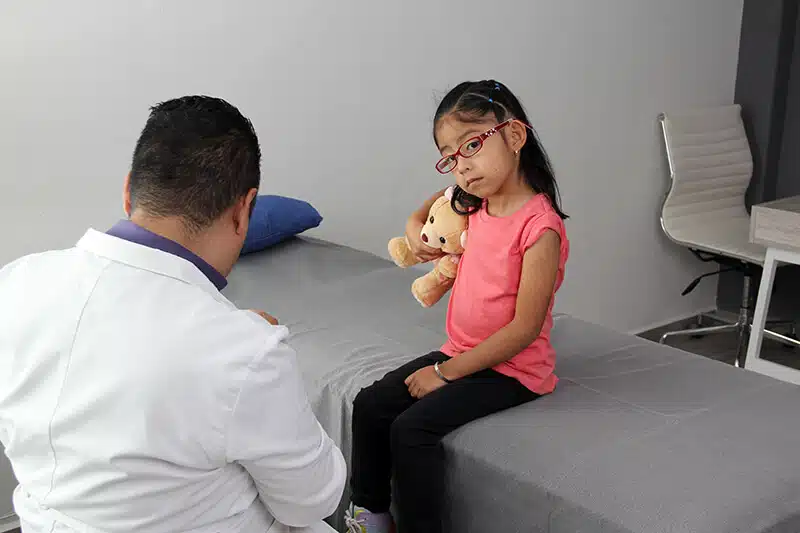
Paediatric Epilepsy Diagnosis and Treatment at Dementech

In order to determine what may be causing your child to have epilepsy and experience seizures, our experts generally conduct a series of tests. The patient may be required to undergo some of the following:
- A neurological exam
- MRI or CT scans for imaging tests of the brain
- Blood tests to check for general blood levels, as well as any problems with blood sugar levels
- Electroencephalogram (used to test electrical activity in the brain)
- Lumbar puncture (spinal tap), to measure the pressure in the brain
Our experienced epilepsy specialists are always happy to provide support to both you and your child if there are any concerns around the types of tests they will be undergoing. We understand that to have a medical diagnosis at a young age can be difficult, which is why we ensure that you have a dedicated specialist across the course of the treatment journey.
Management of Epilepsy in Children at Dementech
At Dementech, we tailor treatment for epilepsy in children to each child’s needs, considering the type, frequency, and severity of their seizures.
Medication is usually the first-line treatment. Our specialists carefully select the right medicine based on your child’s age, seizure type, potential side effects, and ease of use. Most medications can be taken orally, but other options may be available depending on your child’s needs. Your specialist will advise on the most suitable treatment.
Our team provides clear guidance and ongoing support, ensuring that your child’s treatment is effective, manageable, and suited to their daily life.
Meet Our Paediatric Epilepsy Specialists
Our team of paediatric epilepsy experts in London provide expert care to diagnose, manage and treat epilepsy symptoms.

Dr Tahira Choudry – Consultant Neurologist
Epilepsy
Movement Disorders
Neurologist
Parkinson's Disease
Private Neurology
Dr. Maria Papachatzaki – Consultant Neurologist, MS Specialist
Epilepsy
Multiple Sclerosis
Neurologist
Private Neurology
FAQs About Paediatric Epilepsy
Managing epilepsy in children can feel challenging, but Dementech’s specialists are here to support you. Understanding the condition, its risks, and the role of medication is key to controlling seizures. In some cases, children may experience improvements and eventually no longer need medication, but this should always be guided by a healthcare professional.
Regular check-ups and testing are important, as is helping your child understand their condition and any triggers they should avoid, such as lack of sleep. Administering medication correctly, at the right doses and times, is essential, and parents should always consult a specialist before giving additional medications, as some can interact with seizure treatments.
Seizures in children can arise from a variety of factors, and sometimes a combination of them. In many cases, however, the exact cause is not identified. Some potential contributors to epilepsy in children include:
- Imbalances in the brain’s chemical messengers (neurotransmitters) that affect nerve signaling.
- Structural issues such as a brain tumour or stroke.
- Brain injury or damage resulting from illness, trauma, or other medical conditions.
Because causes can vary widely, a specialist evaluation is essential to determine the most likely triggers and guide treatment.
We strive to see all patients within the same week of their enquiry whenever possible, ensuring timely assessment and support for your child.
At Dementech, we provide expert, personalised care for children with epilepsy. This includes quick access to assessments, comprehensive diagnostics, tailored treatment plans, and ongoing guidance for families. Our team supports both your child and your family, helping you manage seizures, understand triggers, and ensure daily life is as normal and safe as possible. Flexible consultation options, including video appointments, are also available.
Not necessarily. The need for ongoing medication depends on your child’s type of epilepsy and how well their seizures are controlled. Some children may see a significant reduction in seizure frequency over time, and under the guidance of a specialist, medication may eventually be reduced or stopped. Regular monitoring ensures any changes are safe and appropriate.
Seizures can vary widely in appearance, from full-body convulsions to brief lapses in awareness or unusual movements. If you notice sudden changes in behaviour, consciousness, or physical activity that are out of the ordinary for your child, it’s important to seek specialist advice. Early assessment helps ensure accurate diagnosis and timely treatment.
Hear what our patients have to say

P Allen

“My family and I experienced one of the hardest times of our lives having to deal with my wife’s deteriorating condition. I would like to personally thank the lovely young lady Zobiaa from Dementech, for showering us with compassion, empathy and genuine care and concern. Her professionalism, high-level customer service and communication, eye for detail, and willingness to go the extra mile to accommodate our needs and make not only my wife, but our whole family, feel as comfortable and supported as possible, is something we will always be grateful for. Thank you so much for your friendly and polite presence Zobiaa and taking the time and effort to build a relationship with us. You really made our visits to the clinic a positive, 5 star experience.”
Anonymous
“Dementech Neurosciences is a relatively new clinic specialising in the scientific assessment and treatment of Parkinson’s Disease. It represents a significant development in the treatment of Parkinson’s and has done a great job of establishing itself and its reputation in a short period of time. The premises are extremely well situated in central London, the consultant neurologists are all at the top of their field in their specialisation of the treatment of Parkinson’s Disease, and the clinical and administrative staff are of a similar standard. The atmosphere of the clinic is positive and the results, in the short period of time I have been able to assess, have been similarly positive.”
N Mohammed
“Have had nothing but kindness and professionalism from Dementech and all their staff. From their initial guidance by Shakeela, through to staff conducting the MRI tests and Dr. Lucio D’Anna for his expertise clarity of explanation, compassion and consideration. Special mention to Zobia, who saved the day with her quick thinking that helped my mother-in-law to obtain extended care. Overall a perfect experience. Cannot recommend them enough.”
Latest blog posts & guides

21st September 2026
How a Private Memory Assessment Works at Dementech
Memory changes can be difficult to understand, particularly when you are not sure whether occasional forgetfulness is simply part of...
21st September 2026
Huntington’s Disease: Early Signs, Genetic Testing and What to Expect
Huntington’s disease is an inherited neurological condition that affects movement, thinking, mood and behaviour. Because the condition develops gradually, its...
21st September 2026
Understanding Mild Cognitive Impairment: Is It Early Dementia?
Forgetting a name, losing your train of thought or walking into a room and forgetting why you went there can...
Contact Details
Opening hours: Monday – Sunday:
08:00 – 20:00
0208 015 4365
Lister House
11 Wimpole Street
W1G 9ST
Harley Street area
London, UK