


Dementia refers to a group of symptoms that occur as a result of a decline in brain function. Symptoms often impact the way individuals think, remember, and communicate and can cause changes in their personality and behaviour.
Many different diseases can cause dementia, and these diseases all affect the brain differently. It is the cause of dementia that determines the type of dementia an individual is diagnosed with.
This blog outlines everything you need to know about the most common types of dementia, including causes and common signs and symptoms. We also take a look at some of the less common types of dementia.
Quick guide:
- The most common type of dementia is Alzheimer’s disease, followed by other types such as vascular dementia, Lewy body dementia, frontotemporal dementia, and mixed dementia.
- Less common types of dementia include atypical Alzheimer’s disease, Creutzfeldt-Jakob disease, Huntington’s disease dementia, and Parkinson’s disease dementia.
- Early diagnosis and intervention can be key to managing dementia and the symptoms associated with the disease.
How many types of dementia are there?
Over 100 different types of dementia have been identified, with Alzheimer’s disease being the most common. Vascular dementia, Lewy body dementia, and Frontotemporal dementia are also common types.
The most common types of dementia
Alzheimer’s disease
Alzheimer’s disease is the most common type of dementia caused by the abnormal buildup of proteins in the brain. The likelihood of developing it increases with age, and the disease typically affects people over the age of 65. However, according to Alzheimer’s Research UK, at least 3 in every 100 people with Alzheimer’s disease are under the age of 65.
The disease is a progressive disorder, meaning its symptoms develop gradually and worsen over time. It might take years before symptoms of Alzheimer’s disease begin to show, and the first signs are typically minor memory problems, confusion, disorientation, changes in personality, and communication issues.
Key signs and symptoms:
- Memory problems
- Thinking difficulties
- Issues with reasoning
- Problems with decision-making
- Language and communication problems
- Changes in mood and personality
- Becoming withdrawn
What can be done:
While there’s no cure for Alzheimer’s disease, treatments focus on managing symptoms and slowing cognitive decline.
If you suspect either you or someone you know is experiencing signs of Alzheimer’s disease, it is important to get a diagnosis to begin treatment or to rule the possibility out.
At Dementech, our affordable private Alzheimer’s assessments help to get accurate, expert-led answers fast.
Our Alzheimer’s diagnostic pathways go beyond a standard assessment and may include advanced brain imaging and blood tests. Our goal is to provide a holistic care plan that helps patients and their families live well with the condition, with ongoing support to adjust the plan as the disease progresses.
Find out more about Alzheimer’s Disease Diagnoses & Treatment.

Vascular dementia
Vascular dementia is a common type of dementia caused by reduced blood flow to the brain. Usually, this is a result of a stroke or mini-stroke, as this can cause damage or disease to the blood vessels in the brain. Narrowed blood vessels can also reduce blood flow to the brain.
When the brain doesn’t receive enough blood, it is unable to carry out functions as it should. This is what causes the symptoms of vascular dementia to occur, and they can develop quickly or gradually over time.
Key signs and symptoms:
- Having trouble planning or organising things
- Difficulties with decision-making and problem-solving
- Finding it difficult to follow a series of steps or instructions
- Thinking more slowly
- Finding it difficult to concentrate
- Experiencing periods of confusion
What can be done:
Since vascular dementia is often caused by reduced blood flow to the brain, treatment should be centred on addressing the underlying cardiovascular risk factors.
Our expert memory clinic consultants at Dementech work closely with patients to manage conditions like high blood pressure, high cholesterol, and diabetes, to manage risks and progression of vascular dementia.
Our private vascular dementia treatment services are focused on stabilising the condition and preventing further cognitive decline.
Find out more about our Vascular Dementia Diagnosis & Treatment.

Lewy body dementia
Lewy body dementia is a progressive type of dementia caused by abnormal clumps of protein (Lewy bodies) forming inside the brain.
Lewy bodies typically build up in areas of the brain that are responsible for thinking, movement, visual perception, and sleep regulation.
There are two subtypes of Lewy body dementia: dementia with Lewy bodies and Parkinson’s dementia. While they share some similar symptoms, such as trouble focusing and memory loss, dementia with Lewy bodies can also cause hallucinations, sleep issues, difficulties with movement, and disturbed sleep.
Key signs and symptoms:
- Problems staying focused on things
- Finding decision-making difficult
- Memory loss and day-to-day issues with memory
- Becoming easily distressed, agitated, and restless
- Issues with movement, such as walking slowly and unsteadily
- Difficulties communicating
- Trouble chewing, swallowing, eating and drinking
What can be done:
Lewy body dementia is a complex condition, and a misdiagnosis is unfortunately common. Receiving an accurate and early diagnosis is key to effective management of the condition.
At Dementech, our neurology specialists and diagnostic pathways work to diagnose conditions with accuracy, care, and compassion. If you suspect a misdiagnosis, are stuck in a long neurology appointment waiting list, or would like a second opinion, we can offer same-week consultations to receive the support you need.
Our private neurology appointments are affordable and patient-focused to offer the best support and quality of life.
Discover more about Lewy Body Diagnoses and Treatments.

Frontotemporal dementia (FTD)
Frontotemporal dementia (FTD) refers to a group of dementias that affect the frontal and temporal lobes of the brain.
Overall, Frontotemporal dementia is a less common type of dementia. It is, however, a more common cause of dementia in people under the age of 65. It typically develops between the ages of 45 and 65.
Frontotemporal dementia is caused when nerve cells in the frontal and temporal lobes of the brain die, causing pathways connecting them to change.
As these areas of the brain are responsible for personality, behaviour, language, and speech, individuals with FTD typically experience behavioural changes and communication issues.
Key signs and symptoms:
- Impulsive and inappropriate behaviour
- Seeming unsympathetic towards others
- Loss of motivation
- Problems with personal hygiene
- Becoming easily distracted
- Troubles with planning and organisation
- Mixing words up and using them incorrectly
- Speaking more slowly
- Moving more slowly
- Muscle weakness
- Trouble swallowing
- Incontinence
What can be done:
Frontotemporal dementia affects personality and behaviour, which makes a precise and early diagnosis particularly important.
Dementech’s specialist team, which includes neurologists and neuropsychiatrists, has the expertise to correctly diagnose FTD. We offer patient-focused, personalised support including targeted speech and language therapies, and strategies to help manage changes in behaviour. Our team also provides crucial guidance and support for families navigating the challenges of FTD.
Discover more about Frontotemporal dementia treatment and diagnoses.

Mixed dementia
Mixed dementia is when two or more types of dementia occur together. Individuals with mixed dementia will experience a combination of the symptoms linked to the different types of dementia they have. This can make it difficult to diagnose and treat.
Any combination of the different types of dementia can be considered mixed dementia, however, some combinations are more common than others. For example, Alzheimer’s disease with vascular dementia is the most common form of mixed dementia, followed by Alzheimer’s disease with Lewy body dementia.
How do you diagnose more than one type of Dementia at a time?
Because there are so many combinations of mixed dementia, there is no set list of symptoms or signs. The symptoms an individual with mixed dementia experiences will depend on the types of dementia they have and the symptoms associated with them.
Diagnosing mixed dementia is difficult, as people will often display a variety of symptoms associated with different types of dementia. This might result in a misdiagnosis of one type of dementia, rather than the presence of multiple types of dementia.
To be diagnosed with mixed dementia, you will first need to talk to your GP for health checks and a basic memory assessment. If dementia is suspected, you will be referred for further assessment, where a healthcare professional can make a diagnosis. Specialist knowledge of the different types of dementia is often required to make a mixed dementia diagnosis.
Less common types of dementia
While Alzheimer’s disease, Lewy bodies, vascular, and Frontotemporal dementia make up the majority of dementia diagnoses, they are not the only types of dementia. If you suspect you or someone you know is experiencing signs of memory loss and issues, it could also be:
Atypical Alzheimer’s disease
Atypical Alzheimer’s starts in a different part of the brain, which causes different symptoms when compared to typical Alzheimer’s disease.
There are two main types of Atypical Alzheimer’s disease: Frontal variant Alzheimer’s disease (fvAD) and Posterior cortical atrophy (PCA).
With fvAD, the frontal lobes of the brain are affected during earlier stages, which happens later in typical cases. This can cause behavioural symptoms like loss of inhibitions and compulsive behaviour, as well as issues with ‘executive function’. This means individuals might struggle with things like following instructions or being easily distracted.
PCA affects the visual cortex in the back of the brain, causing symptoms like difficulty recognising faces and objects, and troubles with spatial awareness and judging distance.
Creutzfeldt–Jakob disease
Creutzfeldt-Jakob disease (CJD) is caused when an abnormally shaped protein, known as a ‘prion’, builds up in the brain. It is not yet known what causes the buildup of prions in the brain.
Symptoms of CJD tend to progress quickly from memory loss and mood changes to problems with movement and communication. They might experience stiffness, shakiness, and jerky movements, as well as incontinence and inability to speak.
Huntington’s disease dementia
Huntington’s disease is an inherited disease which causes a progressive decline in an individual’s movement, memory, thinking, and emotional state. Symptoms usually begin to show between the ages of 35 and 45, though they can also appear in children and young adults.
People with Huntington’s disease may show emotional and behavioural symptoms before they receive a diagnosis, including severe depression, apathy, irritability, and obsessive-compulsive behaviours. A diagnosis will usually be made when they begin to experience issues with movement.
Common symptoms of Huntington’s disease dementia include memory problems, issues with thinking and perception, and loss of the ability to move, eat, and speak.
Parkinson’s disease dementia
Parkinson’s disease dementia is caused by a disease similar to the one that causes dementia with Lewy bodies, though it is thought to start in different parts of the brain. Early symptoms are typically movement-related and gradually progress into dementia-related symptoms.
Common symptoms of Parkinson’s disease dementia include trouble focusing, difficulties with decision-making, memory loss, disturbed sleep, visual hallucinations, delusions, appetite changes and mood changes.

Diagnosing and treating dementia
The typical diagnostic process for dementia starts with making an appointment with your GP, who will conduct initial health checks and basic memory assessments. If your GP believes you might have dementia based on the results of these checks, you will be referred to a specialist or memory clinic for further investigation.
A further assessment will be done by the specialist, and brain scanning might also be arranged. Based on these results, a diagnosis can be made, and you will be told what type of dementia you have and how you can treat or manage the condition.
However, the typical diagnostic process can be long. According to Care England, 1 in 3 people wait over a year for a formal dementia diagnosis, and waiting times for memory clinics can last longer than 2 years.
Get the memory clinic support you need
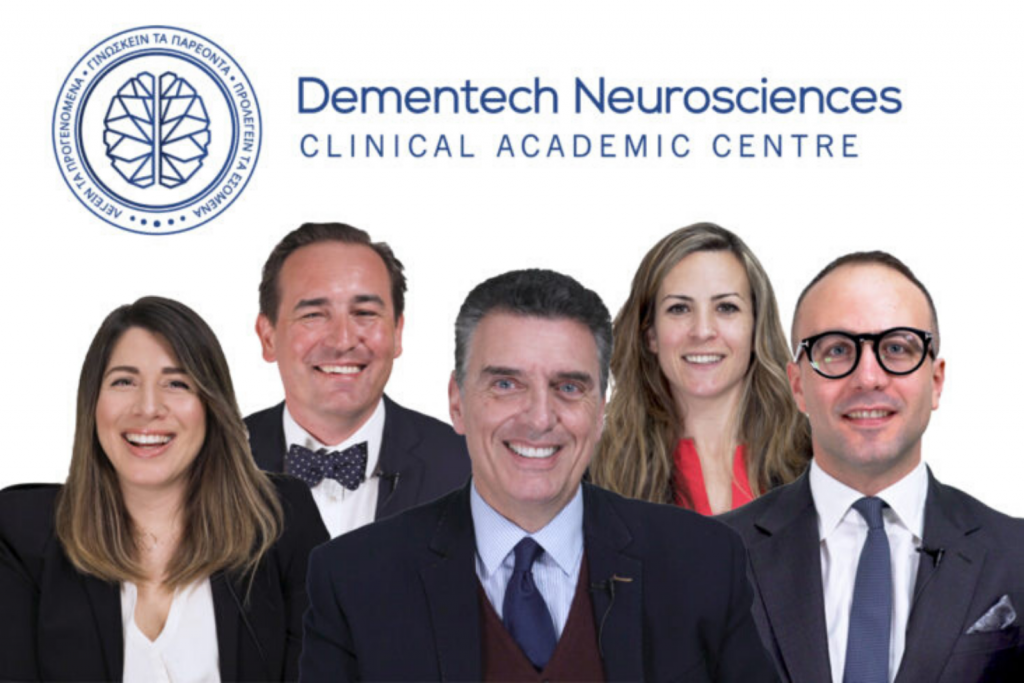
At Dementech Neuroscience, our team of dementia specialists provide private dementia support for patients and family members, including quick diagnosis and tailored treatment plans.
By using specialist, state-of-the-art diagnostic tools, we can help you receive a diagnosis more quickly than you usually would. With same-week appointment availability, no extended waiting times, and test results within 48 hours, we aim to provide you with fast, efficient, and ongoing support tailored to the needs of yourself and your family members.
Contact us for more information about how we can support you and your family through a dementia diagnosis.
Book an appointment to speak to a dementia specialist or schedule a video consultation.